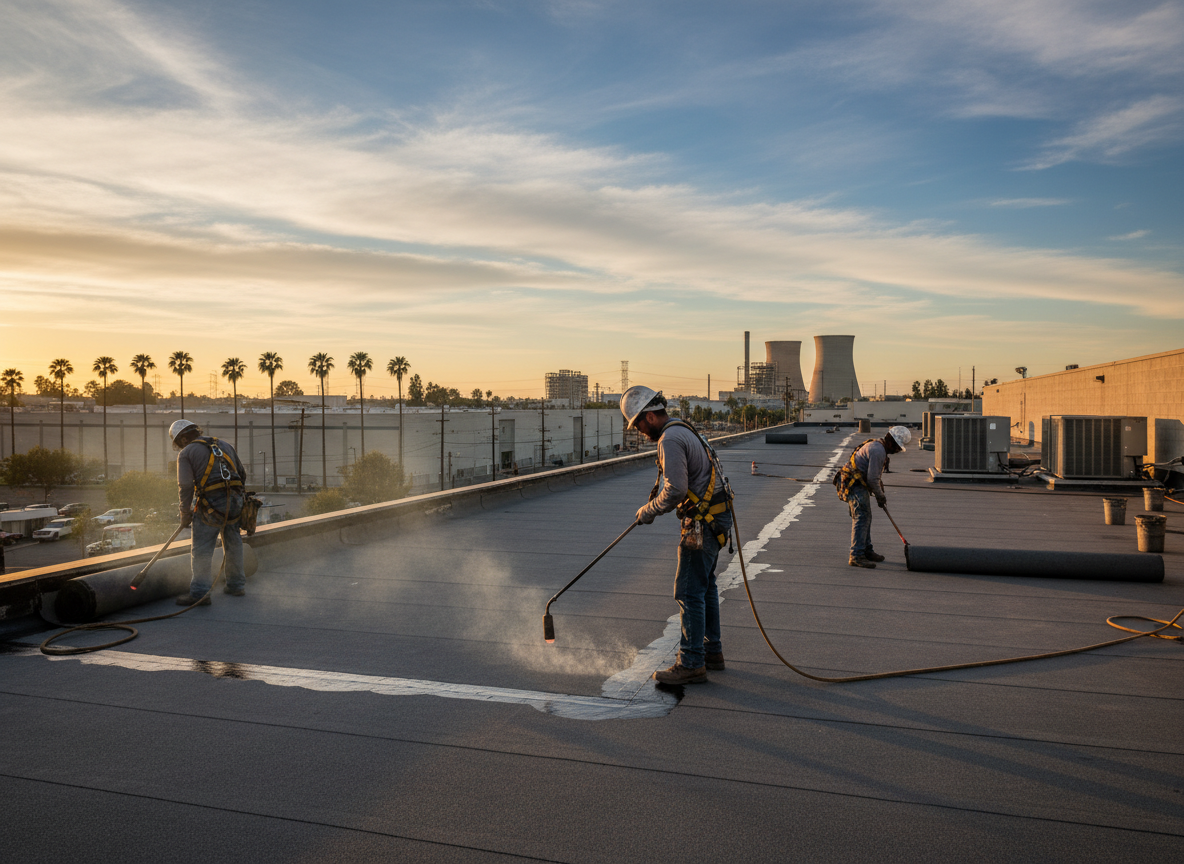
Industrial roofing in South Gate often involves flat or low-slope systems on warehouses and manufacturing buildings constructed decades ago near South Gate City Hall and South Gate Park. These structures frequently feature original built-up or modified bitumen roofs that have endured years of sun exposure in the mild Mediterranean climate. Contractors must evaluate existing insulation, deck condition, and drainage before selecting a replacement system such as TPO or PVC that resists UV degradation and ponding water during rare but intense winter rains.
Los Angeles County building codes require specific wind uplift ratings and fire resistance for industrial projects, especially when work occurs near active operations in Lynwood or Downey. Crews coordinate shutdowns, protect equipment, and ensure new membranes tie into existing flashings around HVAC units and skylights without disrupting production. Soil movement from the region’s occasional seismic activity can also shift parapet walls, creating leak paths that demand reinforced edge details rather than standard residential approaches.
Edge cases include coating aged metal decks common in Huntington Park industrial zones where corrosion has already begun. Proper surface preparation and compatible primers prevent delamination, while ventilation requirements differ from residential work because large interior spaces trap heat and moisture. Owners in South Gate benefit from systems that allow future inspections via walk pads and documented seam integrity to meet insurance expectations.
Technician insight
In South Gate, the thing that catches most people out with Industrial Roofing Contractors is the hidden drainage problems on 1950s-era flat roofs around South Gate Park where original scuppers have been covered by later coating layers and only show up after a winter rain.
Factory Roof Drainage Failure
A manufacturing building near South Gate City Hall reported repeated interior leaks after rain. Inspection revealed clogged scuppers and seam failure on the existing membrane. Crews replaced the drainage system, installed a new TPO overlay with proper slope correction, and added walk pads. The facility returned to full operation without further water intrusion.
How it works
- 1
Site Assessment
Technicians inspect the full roof surface, drainage paths, and penetrations on the industrial structure to identify existing damage and code compliance needs.
- 2
System Recommendation
Material options are presented based on building age, usage, and exposure to Los Angeles County weather patterns, including UV and occasional heavy rain.
- 3
Preparation and Removal
Old roofing layers are removed where necessary, decks are repaired, and the site is prepared while maintaining safety around active operations.
- 4
Installation
New membrane or coating system is installed with reinforced seams, flashings, and drainage improvements suited to South Gate’s flat-roof inventory.
- 5
Final Inspection
Walk-through verifies watertight integrity, documents work, and provides maintenance guidance for long-term performance.
Pricing
Pricing varies by roof size, existing condition, chosen system, and access requirements; contact for a site-specific assessment.