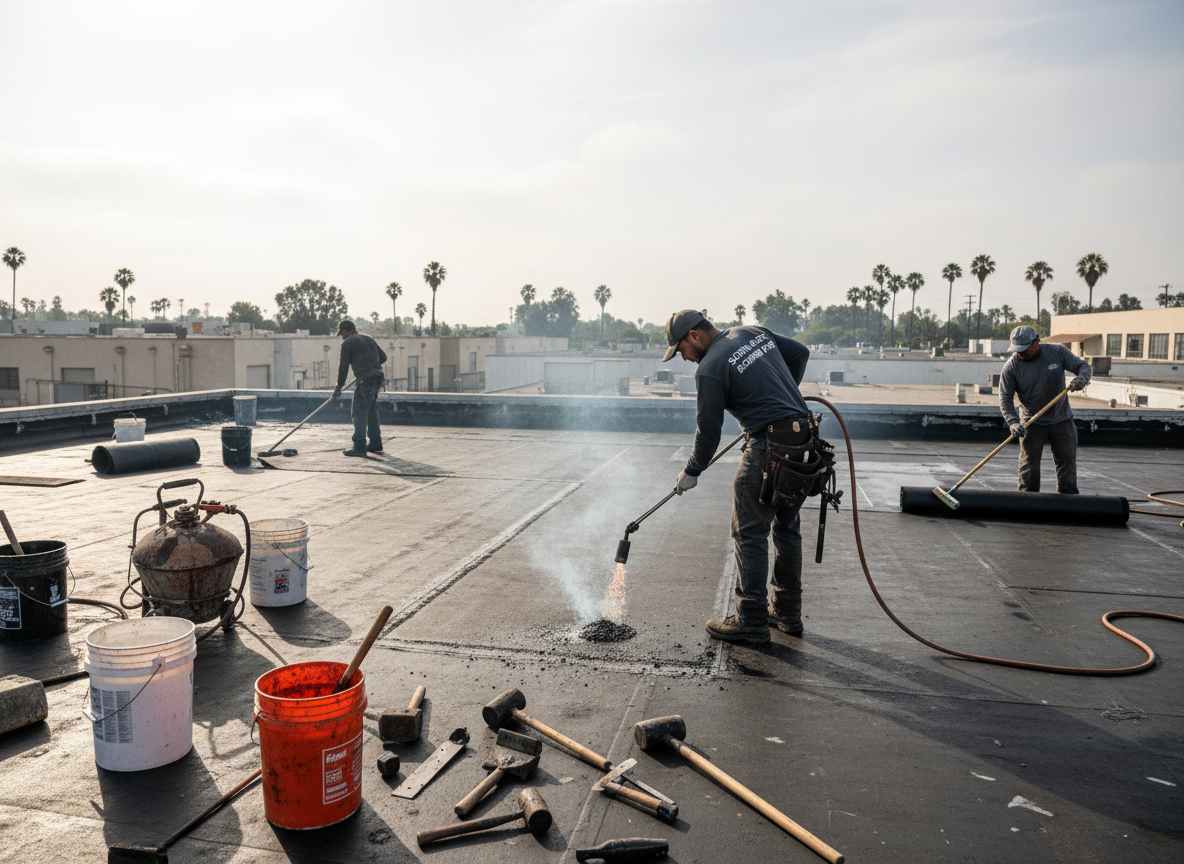
Flat roofs on buildings near South Gate City Hall and along Tweedy Boulevard often use modified bitumen or single-ply membranes that degrade faster under repeated UV exposure and the occasional winter rain events typical of the mild Mediterranean climate. Standing water collects in low spots created by poor original drainage or later settling, especially on structures built before modern slope requirements in Los Angeles County. A repair crew must first locate the exact breach, which frequently hides under layers of prior patches, then cut out saturated insulation before installing new material that ties into the existing system without creating fresh seams that will fail within a few seasons.
Homeowners in South Gate, Lynwood, and Downey commonly discover leaks only after water reaches interior ceilings because the roofs sit behind parapet walls that mask edge deterioration. Technicians check flashing at HVAC curbs and drains first, since these penetrations account for most failures when sealant shrinks from heat cycling. Proper repair also requires verifying that new membrane extends up the parapet at least eight inches and receives mechanical fastening where wind uplift occurs during Santa Ana conditions that reach into the area from the north.
Code compliance in South Gate means any repair exceeding certain square footage triggers review of drainage capacity under current Los Angeles County standards. Crews therefore photograph existing slopes and note ponding depths before work begins so the finished surface meets runoff requirements without adding weight that older joists cannot support. Skipping this step leads to repeated callbacks when the first heavy rain reveals water still sitting against the new membrane.
Technician insight
In South Gate, the thing that catches most people out with Flat Roof Repair is how the mild Mediterranean climate lets small seam splits go unnoticed for years until a single winter rain pools against the parapets on older commercial buildings near South Gate City Hall, turning a surface patch into a full insulation replacement job.
Ponding Leak Near Tweedy Boulevard
Water stains appeared on the ceiling of a single-story commercial building in South Gate after an early rain. Inspection revealed a split seam where prior patches had trapped water against the parapet. We removed the wet insulation, added tapered boards to improve slope, and installed a new reinforced membrane section tied into the existing system. The roof now drains fully and has remained dry through subsequent storms.
How it works
- 1
Site Assessment
Walk the entire roof surface and parapets to map blisters, seam splits, and drainage paths while noting proximity to South Gate Park vegetation that can clog scuppers.
- 2
Moisture Mapping
Use infrared scanning to identify wet insulation zones beneath the membrane before any cutting begins.
- 3
Targeted Removal and Replacement
Cut out damaged sections, install new insulation boards to restore slope, and weld or torch new membrane with proper overlaps.
- 4
Edge and Penetration Detailing
Replace or reinforce flashing at walls, drains, and curbs using compatible materials rated for the local temperature swings.
- 5
Final Drainage Test
Flood the repaired area and monitor for twenty minutes to confirm water exits all scuppers without ponding.
Pricing
Cost depends on roof size, extent of wet insulation, and chosen membrane type; we provide upfront quotes after inspection.